
Good Ol' Marble Sheep
Plus, a 3-hour Marble Sheep tape of blown-out Japanese psych, cosmic love chants, and post-Dead MIDI jams.

Welcome back to Jazz Realities the newsletter arm of the radio show, Jazz Realities, on NQRA Radio. This is the place to read a primer on gorp jazz or learn that you, too, can play Scott LaFaro’s bass. Subscribe to get it all straight to your inbox. Drink to thy friends and recommend them here. A version of the following short essay accompanied the 2016 WFMU Marathon Long Rally Grand Prize, also called Good Ol’ Marble Sheep, which went to one kind listener. Find the audio below.

I don’t recall exactly when I first fell in love with the blown-out heavy guitar jams coming out of Japan. It must have been from one of the Tokyo Flashback comps on the PSF label or perhaps I followed the lineage back from the Ghost records on Drag City. Hearing the swirling dense distortion, repetitive riffing, solo after bloody solo of bands like Mainliner, Overhang Party, White Heaven, Fushitsusha and High Rise, felt like listening to an intensely zoomed-in peaked version of the best part of your favorite song over and over.
In the early 2000s when new bands in the Japanese psychedelic tradition started appearing—LSD March, Suishou No Fune, Majutsu No Niwa, Aural Fit, and the like—I fell hard. Mainliner’s Mellow Out took on ever more meaning and significance. But my favorite of the ilk remains Marble Sheep & the Run-Down Sun’s Children who embodied many similar characteristics: blown-out guitars and torqued amps, big riffs, repetition, drowsy ballads, jams frequently clocking in at the 20 minute mark, occasionally lasting an hour or more—the electric guitar, after so many years, finally utilized to its full potential!
In that first dose of Marble Sheep (what a band name, too) is the inkling of something slightly at odds with the dark energy speed-freak template laid down by High Rise. What’s most noticeable, even on the early Marble Sheep records is a pronounced Grateful Dead influence—the copycat guitar/vocal melodies and bouncy interplay, the epic Jerry-like ballads, the “space” breakdowns, the lengthy jams—that only grew more pronounced as the band dialed back the distortion and blazed on into the 1990s.
In fact, one’s enjoyment or tolerance of later Marble Sheep can be traced directly to one’s enjoyment or tolerance of Go to Heaven-era Dead coupled with the crispy and condensed digital recording technologies run amok in the ‘90s. Admittedly my tolerance is pretty damn high, so I quite enjoy the later less-fried version of Marble Sheep, which is often written off as so much noodling.
“Marble Sheep were not sweet love and peace hippies. We had punk spirits.”
But my point is Marble Sheep were drinking the Grateful Dead’s dosed Kool-Aid from the very beginning, and especially on the most treasured Marble Sheep record, 1989’s 2-disc behemoth, Whirl Live - Good Old Marble Sheep 2, released on Ken Matsutani’s own Captain Trips label. If the label name doesn’t give it up, I don’t know what to tell you. The Dead quotes are many and any Dead fan will recognize them. One can read “Ultra-Man” as a direct rip of “Fire on the Mountain,” as just one example.
Mutant Sounds wrote about Whirl Live back in 2007:
Here’s two more discs worth of Marble Sheep’s early model acid rock attack, soon to go south along with several folks from this line-up and get sonically re-tooled for amiable but underwhelming post-Dead twiddling. Here though, despite the absence of White Heaven’s Michio Kurihara (who’d already left the fold) and an encroaching linearity, they’re still exploring catharsis through massed lysergic guitar explosions to highly winning ends.
The Dead thing was clearly intentional and Marble Sheep was not “re-tooled” so much as becoming more recognizably itself. Marble Sheep’s leader Ken Matsutani, he of White Heaven, had a plan from the very first days of the band (as told to Graham Reid from New Zealand’s Elsewhere magazine):
Our sound was very freak-out so we were always alone. I don’t know if Japan really had a psychedelic, space rock scene. The audiences were clean and very serious. They had no experience of psychedelic and freakout music. There were just a few people familiar with it, the Dead Heads knew psychedelic feelings.
The Tokyo psychedelic scene then had a very black image. Everybody wore black and sunglasses and made a hysterical electric noise. I didn’t want Marble Sheep to join that scene so we wore colorful shirts and left behind that heavy sound jam. We changed our sound from heavy to light.
It became like the Grateful Dead and we succeeded in changing our image. But nobody, no Japanese psychedelic fans, wanted our style so we were playing for few Dead Head clubs and the audience was hippies. But Marble Sheep were not sweet love and peace hippies. We had punk spirits.
Everyone said at the time we sounded and looked like Amon Düül but our technique then was very poor. We played long jams for many people: punks, heavy metal-ers, freak-out people, non-musicians. It was fun but we needed something remarkable and I changed from acoustic guitar to electric guitar . . . and we played Marble Sheep songs with long improvisations.
Is there an American analog to Marble Sheep? After all, the stuff on Whirl Live is American-sounding music, inspired by ‘60s rock. Though to me Marble Sheep sounds both quintessentially American and quintessentially Japanese, drawing a line through the Grateful Dead and back to that band’s earliest rock and roll influences, and extending out to High Rise and Mainliner and White Heaven and on into the ‘90s jamscape. This is music that is being forever played. I once opened the door and walked into this jam-in-progress; I close the door and the jam squalls on.
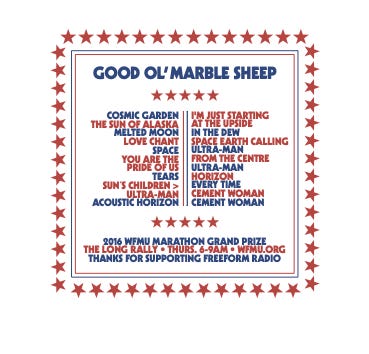
Good Ol’ Marble Sheep Tape
Much of Marble Sheep’s music is available for purchase direct from the source on Ken Matsutani’s Bandcamp page. A ton of great stuff beckons. Repeated songs reveal wildly different versions.
Side A:
Cosmic Garden
The Sun of Alaska
Melted Moon
Love Chant
Space
You are the Pride of Us
Tears
Sun’s Children > Ultra-Man
Acoustic Horizon
Side B:
I’m Just Starting at the Upside
In the Dew
Space Earth Calling
Ultra-Man
From the Centre
Ultra-Man
Horizon
Every Time
Cement Woman
Cement Woman
hell yes scott mcdowell